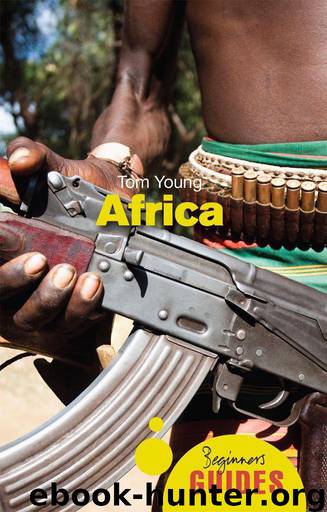
Africa (Beginner's Guides) by Young Tom
Author:Young, Tom [Young, Tom]
Language: eng
Format: mobi
ISBN: 9781780741260
Publisher: Oneworld Publications (academic)
Published: 2012-06-19T23:00:00+00:00
Stagnation and decline: external dynamics
Arguments have raged (and doubtless will continue to do so), as to the best explanation of Africa’s decline into economic stagnation and political instability after the early promise of independence. On the one hand the terrible disappointments of Africa’s independence so far, combined with powerful feelings of guilt about colonialism and racism, have encouraged tendencies to blame all reverses on outside forces, whether ‘the colonial legacy’, or multinational corporations or malign Western governments or anything, so long as it is not Africans themselves. On the other hand there are those who focus almost exclusively on Africa’s shortcomings, real or imagined, oblivious to the operation of other factors. Once people become committed to such standpoints they find it difficult to see any virtue in any other point of view, but it is worth making the effort to make the best sense we can of factors internal and external to the continent.
I have argued that the dynamics that produced the deteriorating situation in many African countries from the 1970s onwards were largely internal to African states. They would have occurred whatever the wider international economic and political circumstances. But it would be foolish to ignore the fact that there were international factors that had damaging consequences for African countries, and often exacerbated the tendencies in African politics which we have identified. In both political and economic contexts some of these factors were intentional and aimed at African states, while others were more the unintended by-product of the workings of international forces. Three factors stand out. The first was the unfinished business of ending colonial rule, including that very peculiar form of it, South African apartheid. Because Britain and France had been prepared to surrender their colonies, and had done so by the 1960s, it is easy to forget that Portugal continued to vigorously defend its Empire and that both white Rhodesians and white South Africans continued to defy both the black majority in their own states and increasingly vehement international opinion. The second factor that caused difficulties, for at least some African countries, were the entanglements of the Cold War and especially the heightened tensions of the period of intensified American global activism after 1980. Finally, having looked at the internal difficulties of African states and their economic strategies, we need to take account of how wider international developments helped to some extent to derail those strategies.
On 3 February 1960 the British Prime Minister Harold Macmillan made his famous speech to the South African Parliament in which he said, ‘The wind of change is blowing through this continent, and whether we like it or not, this growth of national consciousness is a political fact. We must all accept it as a fact, and our national policies must take account of it.’8This was a fact his audience were extremely reluctant to take account of. Nor were white audiences in Rhodesia or Portugal any more inclined to. When the tide of independence swept Africa these states had done little to oppose it and were even prepared to live with it.
Download
This site does not store any files on its server. We only index and link to content provided by other sites. Please contact the content providers to delete copyright contents if any and email us, we'll remove relevant links or contents immediately.
| Arms Control | Diplomacy |
| Security | Trades & Tariffs |
| Treaties | African |
| Asian | Australian & Oceanian |
| Canadian | Caribbean & Latin American |
| European | Middle Eastern |
| Russian & Former Soviet Union |
The Secret History by Donna Tartt(19103)
The Social Justice Warrior Handbook by Lisa De Pasquale(12197)
Thirteen Reasons Why by Jay Asher(8919)
This Is How You Lose Her by Junot Diaz(6894)
Weapons of Math Destruction by Cathy O'Neil(6284)
Zero to One by Peter Thiel(5808)
Beartown by Fredrik Backman(5767)
The Myth of the Strong Leader by Archie Brown(5513)
The Fire Next Time by James Baldwin(5454)
How Democracies Die by Steven Levitsky & Daniel Ziblatt(5225)
Promise Me, Dad by Joe Biden(5157)
Stone's Rules by Roger Stone(5091)
A Higher Loyalty: Truth, Lies, and Leadership by James Comey(4966)
100 Deadly Skills by Clint Emerson(4931)
Rise and Kill First by Ronen Bergman(4797)
Secrecy World by Jake Bernstein(4756)
The David Icke Guide to the Global Conspiracy (and how to end it) by David Icke(4723)
The Farm by Tom Rob Smith(4517)
The Doomsday Machine by Daniel Ellsberg(4493)
